
Daily Updates from the 2026 International AIDS Conference

Daily Updates from the 26th International AIDS Conference
Check back each day for amfAR-related news from the conference and updates on HIV cure research and other breakthroughs.
July 30, 2026

Vice President and Director of Public Information
Elizabeth Taylor Human Rights Award
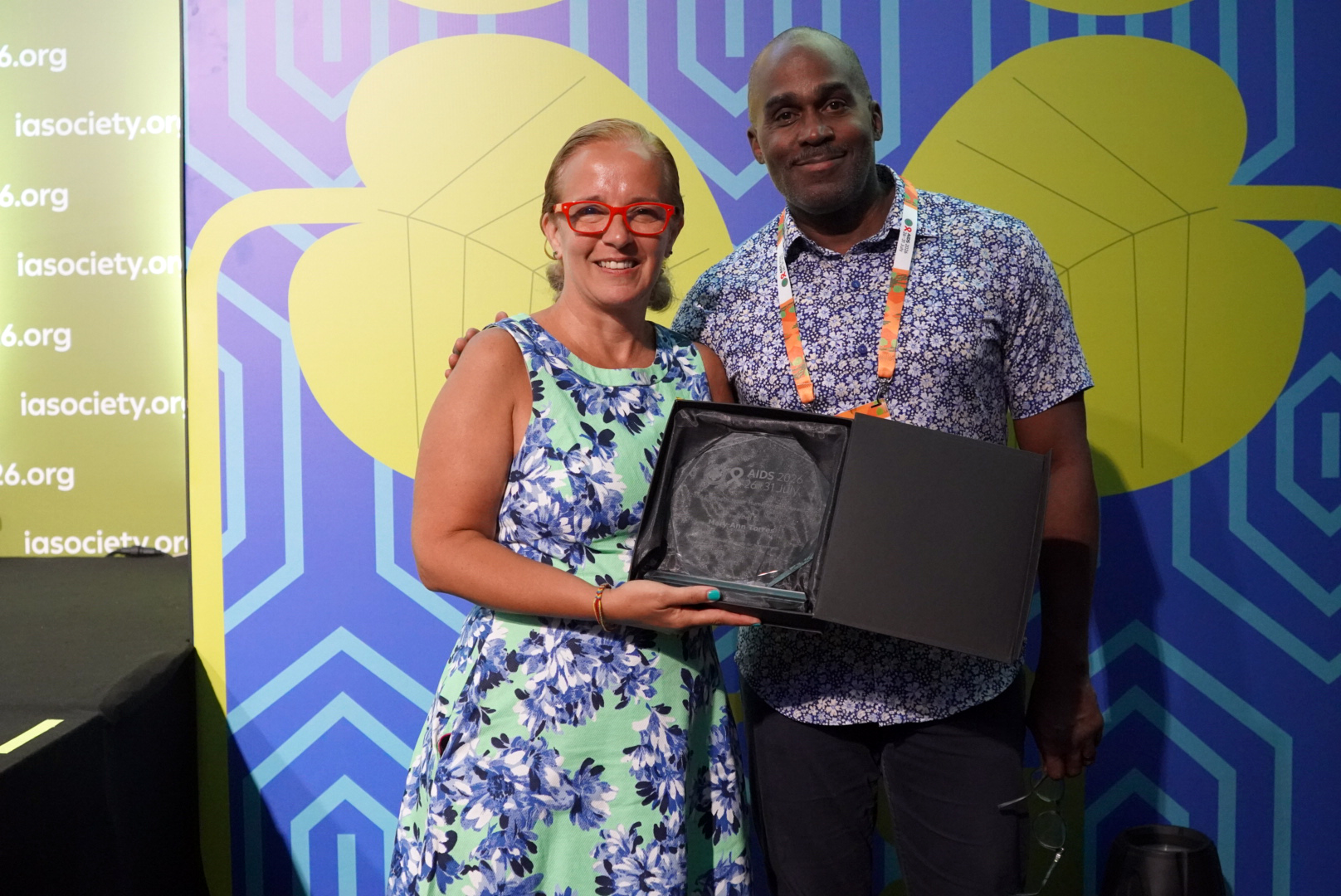
Mary Ann Torres is the recipient of this year’s Elizabeth Taylor Human Rights Award. She is a Venezuelan lawyer and AIDS policy expert who, until recently, lead the International Council of AIDS Service Organizations (ICASO), which was forced to close last year due to the decline in global health funding. ICASO was a network dedicated to advancing the rights, health, and wellbeing of communities affected by the HIV epidemic.
The Elizabeth Taylor Human Rights Award is presented biannually at the International AIDS Conference, supported by amfAR in memory of our Founding International Chairman, Dame Elizabeth Taylor.
July 29, 2026

Vice President of Research
A Seat at the Table
Today, I was appointed to the IAS Corporate Partnership Program Steering Committee. I’m honored to be a part of this group that serves a networking function between industry partners in the HIV response and community groups, academia, and civil society.
I look forward to contributing the perspective of an independent research funder and helping foster productive collaborations across the whole spectrum of actors in the HIV field. This cross-sector cooperation is imperative to not only drive innovation, but to make sure these innovations are positioned to actually benefit the people who need them.
As a member of the Steering Committee, I’ll play a role in not just strategic direction, but in selecting the six priority tracks, or urgent problems, that we are looking to solve.

Senior Policy Associate
PEPFAR Pulse Takes the AIDS 2026 Stage
It was an extraordinary honor to be selected to present the findings of the PEPFAR Pulse Study during today’s Co-Chairs’ Choice session. As I said during my presentation, it’s important to understand the current state of affairs, if we’re going to be able to figure out how to keep the HIV response moving forward.
What I believe to be the single most important finding in the study is this: while HIV treatment remains stable, for now, services directly designed for members of key populations—that’s members of communities that represent more than half of new HIV acquisitions worldwide—have completely collapsed. Nearly three out of every four organizations previously providing key population services had to stop at least one.
That is a house of cards and we can’t end HIV as a public health threat if we’re not reaching the people most impacted by the virus.
The response to our report has been incredible, and I was pleased to field some really thoughtful questions from the audience about the study. Now it’s time to look back into the data to see if there are any other stories it can tell about the state of the HIV response.
July 28, 2026

Vice President and Director, TREAT Asia
Helping Researchers Navigate Scientific Publishing
In collaboration with the Journal of the International AIDS Society, I helped conduct a workshop Tuesday on writing and publishing research papers. Although there is a lot of online guidance about how to write papers, these workshops give people the chance to hear extra tips and insights from the people who make decisions about accepting or rejecting their papers.
Demystifying the publication process helps to democratize science, especially for new generations of researchers who will be pushing the field forward into the future.
A key objective is to help people understand common reasons for rejection so they can think through how to optimize their chances of acceptance.

Associate Director, Program Communications
AIDS 2026 Opens

(Photo © Andréa Testoni / IAS)
The International AIDS Conference kicked off, at least officially, at an opening session haunted by a single question: what does the HIV response look like now? In just a year, more than $2 billion in donor government funding for the HIV response in low- and middle-income countries has simply vanished, and the question of how to close that massive gap was front and center as a series of speakers took the stage to address the convened crowd of researchers, advocates, and policymakers.
The next phase of the HIV response will be “a battle, fought on three fronts,” UNAIDS Executive Director Winnie Byanyima said. “Rights, science, and financing.” Hers was one of several speeches to emphasize that a transition to a locally owned HIV response will not be possible without directly addressing the debt crisis. A UN report last month confirmed that 3.4 billion people worldwide live in nations that spend more each year on interest payments than health or education.
And it’s not an opening session at the International AIDS Conference without a protest. Citing figures from amfAR’s recently released PEPFAR Pulse Study, activists took the stage to decry cuts to funding for the HIV response, to demand wider access for HIV treatment and prevention, and to demand a cure.
The discussion about rights came amid reporting that, in 2026, 168 countries criminalized sex work, 66 countries criminalized same-sex sexual relations, and 14 countries criminalized transgender people, all communities already disproportionately impacted by HIV. However, it was the leadership of the most impacted communities in the HIV response that took center stage, with nearly every speaker calling for continued investment in community led organizations.
“Today I am here to declare that we shall rise above it,” Alexus D’Marco of the United Caribbean Trans Network (UCTRANS) said. “Rising above the noise means amplifying science, evidence, and human rights, even when they are inconvenient. It means dismantling the barriers of stigma that still keep too many in silence.”
Of course, the third front, science. The conference is already abuzz with anticipation for the research to be presented in the coming days: two potential HIV cure cases, further innovation in long-acting antiretroviral and prevention medicine, and a host of sessions spotlighting new HIV cure strategies. In her remarks, International AIDS Society president and conference chair Dr. Beatriz Grinsztejn noted that the conference marks 30 years since the introduction of highly active antiretroviral treatment revolutionized HIV treatment and 15 years since the initial research that showed a person living with HIV with an undetectable viral load cannot transmit the virus to others (U=U) was presented at the International AIDS Conference in Rome.

(Photo © Andréa Testoni / IAS)
But the evening’s most rapturous response came when Brazil’s Minister of Health Dr. Alexandre Padilha took the dais to present Brazil’s recent wins in its HIV response as a model for other countries. Last year, Brazil became the first country with more than 100 million residents to eliminate mother-to-child HIV transmission and has increased the number of people accessing prevention medications by 41% over the past year.
As the first ever International AIDS Conference hosted in South America kicks off in Brazil, it seems our host country’s resilience and dedication to ending HIV as a public health threat will serve as inspiration for an HIV response in upheaval.
July 27, 2026
Associate Director, Program Communications
“The Question Is No Longer Whether We Can End AIDS, the Question Is Whether We Choose to End AIDS“
To coincide with the first day of the International AIDS Conference, UNAIDS released an update to its annual report on the global state of the epidemic, which Executive Director Winnie Byanyima described as telling two stories: “the first one of extraordinary scientific progress … the second is a warning.”
As of December 2025, 32 million people living with HIV were accessing antiretroviral therapy, but, last year, new HIV infections rose in three of the world’s five regions. More than half of all children currently living with HIV do not have access to medications.
“Progress is slowing,” Byanyima said at a press conference to mark the start of the conference. “Every day, around 3,400 people acquire HIV. Every day, around 1,600 die from AIDS-related illnesses. The HIV pandemic is not over; without urgent action it could resurge.”
The report shows international funding for the HIV response has hit its lowest level in nearly two decades: falling from $8.8 billion (U.S.) in 2024 to $7.3 billion in 2025, a reduction of 18%.
“I am alive today because of science, because of activism, and a community that came together,” Erika Castellanos of GATE (Global Action for Trans Equality) said during the conference’s opening press conference. “Fund the HIV response like lives depend on it. Because they do.”
July 23, 2026

Senior Staff Writer
amfAR at AIDS 2026
The theme of this year’s conference is “Rethink. Rebuild. Rise.” and these words will be on everyone’s mind as an estimated 10,000 advocates, researchers, and policymakers from around the world gather in person and virtually in Rio de Janeiro, Brazil for the International AIDS Society’s biannual conference, AIDS 2026. Among them will be representatives from amfAR and amfAR-funded researchers who are participating in more than 20 sessions and poster presentations.
Highlights include:
July 28: Greg Millett, MPH, amfAR Vice President and Director of Public Policy, will moderate a session entitled “Economics of impact: Costing studies across the cascade” which will highlight research on long-acting HIV treatments, as well as programs to provide PrEP and HIV testing at lower costs.
July 29: Elise Lankiewicz, MPH, amfAR Senior Policy Associate, will present the findings of amfAR’s PEPFAR Pulse Study at the Co-Chairs’ Choice session, moderated by AIDS 2026 Co-Chairs Draurio Barreira, Claudia Cortes, and International AIDS Society President Beatriz Grinsztejn.
July 29: Kyle Clifford, amfAR CEO, will moderate the session “Safeguarding space and services for key populations in the face of shrinking resources,” which will explore novel strategies to ensure members of communities most impacted by HIV maintain access to prevention and care in the wake of cuts to funding and HIV programs worldwide.
July 31: Nadia Roan, PhD, amfAR grantee, will discuss the cell makeup of the active viral reservoir, the primary barrier to an HIV cure, and how this latent HIV can persist for decades in a session entitled “Unlocking HIV control: Host-virus genetics, immunity, and the path to a cure.” Dr. Roan is currently part of an amfAR-supported collaborative study using AI-enabled science, The HIV Immune Atlas Study, a groundbreaking effort aimed at transforming scientific understanding of how HIV affects different cell types and the immune system at large.
Last Updated: Thursday, July 30, 2026