amfAR Trustee Phill Wilson reflects on his journey living with HIV for over four decades—his personal losses, his HIV advocacy, and staying on top of his health as he ages
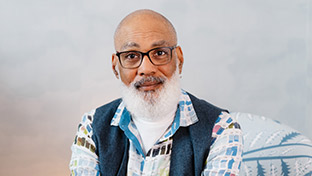
“I never expected to turn 70. I didn’t plan on turning 70, but here I am,” Phill Wilson, founder of the Black AIDS Institute (BAI) and amfAR Trustee, said of his recent birthday. “And I’m not only 70, but I’m 70 with HIV and I’m 70 with diabetes and I’m 70 with heart disease and I’m 70 with liver disease and kidney disease….”
So, like others aging with the virus, he has embraced an approach to health that takes into consideration the whole person, not only HIV. With his virus well-controlled, he spends more time with his cardiologist and specialists treating his other conditions than he does with his infectious diseases doctor, he shared.
Interestingly, he noted, many of the medications used to treat these conditions “have an origin story that involves research that was done around HIV.”
That HIV research was jumpstarted in the 1980s, thanks in large part to amfAR, because people like Phill and his partner, Chris Brownlie, were living with a virus that was destroying their immune system without any effective treatments to stop the damaging effects.
When diagnosed in 1985, Phill’s doctor told him he had six months to live and that he should put his affairs in order.
Phill knew he had a decision to make: “I could go home and prepare to die, or I could focus on the living. I decided that I would focus on the living because the dying didn’t need my help.”
Taking life day by day, he kicked his HIV advocacy efforts into a higher gear as he helped care for his partner, who had already experienced several bouts of AIDS-related illnesses.
Any pressure he felt about living with HIV didn’t come from dwelling on his own mortality. The pressure came from “responding to the constant crisis of the pandemic,” whose effects still resonate today.
“I talk about it sometimes in the context of PTSD [post-traumatic stress disorder],” said Wilson, referring to the condition brought to light by the experiences of people in the military who had seen the horrors of war. With HIV, “we were in a war zone for decades…where there was no relief in sight.”
Chris died in 1989, leaving behind a legacy of AIDS care advocacy, and Phill continued with his own HIV-related work, eventually zeroing in on the disproportionate burden of HIV in Black communities by founding and leading BAI to mount an effective, community-owned response.
He did experience his own health challenges and even brushes with death, but for the most part HIV became chronic and manageable early on for him.
“Thanks to amfAR and others, my health was very strong for most of the pandemic,” Phill said, referring to the amfAR-funded research that led to the development of four of the six main classes of antiretrovirals still in use today.
Initially tapped by Dr. Mathilde Krim, amfAR Founding Chairman, for the organization’s policy committee, Phill was drawn to amfAR because he realized how much of an impact its research and advocacy had made on his personal life. About his decision to join amfAR’s Board of Trustees in 2019 after he retired from BAI, he pointed to amfAR’s commitment to end AIDS once and for all: “I thought, we can wage this fight forever, or we could try to solve the problem.”
That problem-solving involves funding innovative HIV cure research as well as research into other diseases where viruses and the immune system play a critical role, frequently brought to light particularly because many people living with HIV are now growing older and facing age-related health conditions.
“What a remarkable resource amfAR is in addressing a whole host of other disease states that we’re concerned about these days—cancers, Alzheimer’s and dementia, and autoimmune disease,” Phill said in closing. “amfAR was important in the early days of the AIDS pandemic, and it continues to be in the current HIV pandemic.”


