
The Next Step on the Path to an HIV Cure
Building on decades of CCR5 discoveries, amfAR grantee Dr. Jonah Sacha is advancing a new strategy to target the virus
By Kelsey Hopland, PhD
Key Points:
- After decades of research, CCR5, a key protein that HIV uses to infect cells, has emerged as one of the most promising targets for an HIV cure.
- A failed experiment led Dr. Jonah Sacha at OHSU to rethink how to target CCR5. His team’s latest gene therapy approach helps control HIV infection with just one treatment.
- The work brings researchers one step closer to an HIV cure while revealing important new questions for the field.
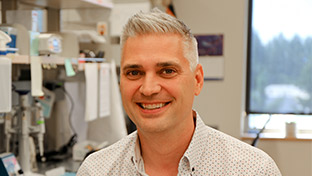
(Photo courtesy OHSU/Christine Torres Hicks)
HIV biology is intertwined with, and essentially inseparable from, a key protein: CCR5.
In the 1990s, an amfAR grant to Dr. Nathaniel Landau supported the seminal finding that HIV requires CCR5 to infect cells. Subsequently, scientists discovered that people born without a functional version of CCR5 are naturally resistant to HIV infection. These findings, combined with several HIV cure cases arising after stem cell transplants from CCR5-deficient donors, elevated CCR5 as one of the most promising targets in HIV cure research.
Decades later, Dr. Jonah Sacha at the Oregon Health and Science University (OHSU) is advancing CCR5-centered HIV cure strategies using novel technologies.
Advances don’t happen overnight. In the 2010s, supported by amfAR funding, Dr. Sacha sought to create a monkey model that was genetically modified to lack functional CCR5. It didn’t work.
Rather than abandoning the idea, he changed the question: “Could we use a molecule to block CCR5?” Instead of removing CCR5, could we prevent HIV from using it?
To explain why that might work, he relies on analogy: “CCR5 is like a lock on the outside of the cell surface, and HIV is like a key,” he said. “It’s able to go into that lock and unlock it and then enter the cell.” But, without access to the lock, HIV can’t get in.
Dr. Sacha leveraged connections with a nearby biotech company to acquire an antibody called leronlimab, which binds CCR5. Leronlimab blocks the lock before HIV can reach it. Recent studies from Dr. Sacha’s lab showed that weekly injections of leronlimab could suppress infection and viral replication in monkeys and humans, demonstrating CCR5 ‘lock blocks’ could effectively shut out HIV.
But those successes raised new challenges. Antiretroviral therapy (ART) already allows most people living with HIV to lead long, healthy lives. Weekly antibody injections, even if effective, would be difficult to justify over simple daily pills or long-acting ART.
“This is great,” he remembers thinking, “but no one really wants to stick a needle in themselves every week if they don’t have to. How can we do this as a one-and-done injection?”
That question became the foundation for his lab’s latest study, published in April. Instead of repeatedly dosing antibodies, Dr. Sacha’s team decided to teach the body how to make them itself. Using a harmless virus system, the researchers delivered genetic instructions for producing CCR5-blocking antibodies. Essentially, rather than shipping in fresh ‘lock blocks’ with weekly infusions, the body becomes a factory that continuously manufactures them. In several monkeys, a single gene-delivery treatment produced enough antibodies to suppress HIV-like virus for months or even years.
Then, the study took an unexpected turn. Some animals stopped producing the antibody after mounting an immune response against it. The team assumed the therapy had failed. But, months later, the antibody came back.
“We were completely shocked,” Dr. Sacha said. “We thought, ‘This can’t be right. You’ve got to repeat this. This doesn’t happen.'” As additional animals showed the same pattern, the team realized they had uncovered something exciting about how gene therapies interact with the immune system.
“When it works, it works really well. It’s exciting,” he said. “But the other take-home is this re-expression phenomenon. We clearly don’t understand how these long-term therapies are being regulated by the immune system over time.”
This study is a proof-of-concept that gene therapy can transform the body into a long-term factory of an HIV-blocking antibody and possibly lead to functional cure. It also reveals some of the challenges researchers must overcome before this approach can be translated from the lab into a clinical success.
A CCR5-directed antibody or one-time gene therapy may not be the magic bullet. Dr. Sacha envisions a rational combinatorial approach: “I think you have to pair it with a broadly neutralizing antibody. You would need overlapping coverage from distinct mechanisms to stop HIV, for a functional cure.”
The discovery is a testament to the long-term vision of robust scientific funding, and the circuitous and iterative path of research. “All this came originally from an amfAR investment a decade ago,” Dr. Sacha acknowledges.
This latest study isn’t the end of that journey, just another promising step forward.
Dr. Kelsey Hopland is the program officer of amfAR’s research department.
Share This:
