Supporting up-and-coming HIV researchers, the amfAR Krim Fellowship has produced a strong track record of scientific achievement
Key Points
- amfAR’s Mathilde Krim Fellowship in Biomedical Research allows HIV researchers new to the field to work with seasoned mentors.
- The Krim Fellowship helps scientists working on HIV establish long-term careers.
- Krim Fellows have made a significant impact on the field of HIV research through published studies, conference presentations, and secured grants.
Early-career scientists benefit from a supportive research ecosystem, and that’s exactly what amfAR’s Mathilde Krim Fellowship in Biomedical Research has sought to foster for nearly two decades.
Created in 2007, the Fellowship in part aims to alleviate the scarcity in opportunities for early-career development in biomedical research focused on the prevention, treatment, or cure of HIV/AIDS. The funding opportunity complements amfAR’s Target and Horizon grants, which support innovative research addressing health challenges where viruses and the immune system play a defining role.
Named in honor of amfAR’s founding chairman, the Krim Fellowship has supported 69 researchers with nearly $11.8 million in funding across 96 grants, which include Phase 1 ($180,000) and, for Fellows who secure an independent position, Phase 2 ($50,000).
The benefits afforded researchers include but are not limited to mentorship, a boost toward establishing an independent career, and a critical investment in bold projects.
Mentoring Promising Scientists
One of the principal strengths of the Mathilde Krim Fellowship program is that grant recipients work under the mentorship of seasoned HIV researchers while carving out a distinct scientific niche of their own.
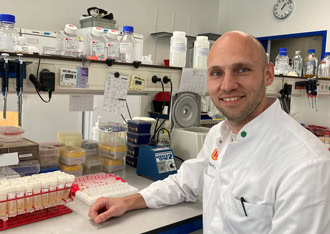
The Krim Fellowship has such a deep bench that mentors have even come from within the program. For example, a recent amfAR Fellow, Dr. Steven de Taeye (Krim ’23, ’25) of Amsterdam University Medical Center (Amsterdam UMC), was mentored by two established principal investigators who were also prior Krim Fellows, Dr. Rogier Sanders (Amsterdam UMC; Krim ’07, ’10) and Dr. Marit van Gils (Amsterdam UMC; Krim ‘16, ‘18). Of note, Dr. van Gils was also formerly mentored by Dr. Sanders as part of the Krim Fellowship.
In order to further strengthen the network of mentorship, amfAR recently started an initiative to match early-career investigators who are current or former Fellows with established researchers for career development, project planning, grantsmanship, and other tasks.
Supporting Scientific Careers
The Fellowship has been critical in helping scientists establish research careers.
Over 35% of Krim recipients, in fact, have gone on to secure Phase 2 funding, meaning they quickly established scientific independence.

Many Fellows have attained productive careers as principal investigators, including Drs. Judd Hultquist (Krim ’16, ‘18) of Northwestern University; Aleksandar Antanasijevic (Krim ‘21, ‘22) of École Polytechnique Fédérale de Lausanne in Switzerland; and Jeannette Tenthorey (Krim ‘22, ‘23) of University of California, San Francisco (UCSF), among others.
One of the Fellows who completed a recent survey put it this way: “Please keep this program going as I cannot stress enough how beneficial it has been for my career progression. I will forever be grateful for your kind support that allowed me to reach my dream job and further supported me throughout the early, challenging phase of independence.”
Promoting Breakthrough Research
Krim Fellows past and present have a strong record of innovative research, publishing in high-impact journals, presenting at major conferences, and securing faculty positions and major grants from the NIH and other institutions.
At AIDS 2026, the premier HIV conference, Drs. Gabriel Duette (Krim ’24, ‘26) of the Westmead Institute and the University of Sydney in Australia and Francisco Zapatero Belinchón (Krim ‘25)of the Gladstone Institutes each presented different studies aimed at controlling HIV in a cure context.
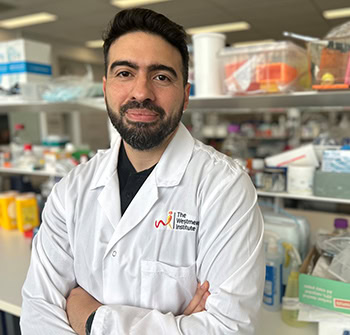
Dr. Ujjwal Rathore (Krim ‘21) of the Gladstone Institutes/UCSF, recently spearheaded a major HIV CRISPR study focused on finding genes instrumental in HIV infection of T cells, and in March 2026 he joined the amfAR Research Council (aRC) as a junior member to help guide the organization’s research directions.
Thus far, the Krim Fellowship has helped generate 244 publications and/or articles shared online ahead of print that feature a Krim Fellow author and directly acknowledge a Krim Fellowship.
“Dr. Krim’s exemplary scientific achievements and her exceptional personality will be an inspiration for several generations of biomedical scientists,” noted Dr. Stylianos Bournazos (Krim ’14,’16) of The Rockefeller Institute in New York, who recently received a Target grant from amfAR to study boosted antibodies as part of a strategy to control HIV. “For me, it has been a privilege to be the recipient of a fellowship named after Dr. Krim.”
The next class of Krim Fellows will be selected in the coming months. The closing date for letter of intent submissions is November 12. For more information, click here.


